
Online Reputation Management × ADR
Why Review Responses Impact Hotel Average Daily Rate (ADR)
How Online Reputation Management Directly Influences Hotel Pricing Power
Hotel revenue teams spend an enormous amount of time protecting ADR performance.
The Reputation Lab · Built around revenue outcomes
Directors of Revenue are constantly adjusting hotel pricing strategies based on market demand, occupancy pacing, seasonality shifts, competitor movement, and compression periods. Directors of Sales are focused on protecting group business, driving corporate contracts, and maximizing high-value bookings. General Managers are balancing operational execution, staffing realities, guest satisfaction scores, and ownership expectations.
These teams understand hotel pricing strategy extremely well.
What often receives far less strategic attention is how online reputation management — specifically hotel review responses — influences whether travelers believe a hotel’s average daily rate is justified before they ever book.
Today’s travelers validate hotel pricing before they commit to it.
Tripadvisor
TrustYou
Cornell University
Research from Cornell University School of Hotel Administration found that a 1-point improvement in hotel review scores can allow properties to increase average
daily rate (ADR) by up to 11.2% while maintaining occupancy levels.
That data reinforces a critical reality for hotel revenue leaders: your hotel pricing strategy does not operate independently from your online reputation management strategy.
When travelers encounter unresolved guest complaints, inconsistent hotel management responses, or public silence around operational issues, they become more price-sensitive. That hesitation creates lower hotel booking conversion, increased OTA comparison shopping, longer booking windows, greater discount pressure, and reduced hotel pricing flexibility.
Hotels that actively manage review responses as part of a structured online reputation management program create measurably different revenue outcomes — reducing booking hesitation, reinforcing operational credibility, and making premium hotel ADR easier to justify and sustain.
At The Reputation Lab, we help hotels align hotel review response strategy with long-term average daily rate performance and revenue growth.
The Core Premise
Why Hotel ADR and Online Reputation Management Are Inseparable
Most hotels still treat hotel review responses as a guest service responsibility — something handled by front office teams or general managers when time allows.
In reality, hotel review responses influence multiple hotel revenue outcomes simultaneously:
- Hotel booking conversion rates
- Direct booking channel performance
- OTA dependency and commission exposure
- Group sales confidence and meeting planner decisions
- Premium hotel pricing perception
- Long-term hotel brand value and market positioning
According to ReviewTrackers, 53% of travelers expect hotel management to respond to negative reviews within one week. When hotels fail to respond consistently, potential guests draw their own conclusions — that the issue still exists, that hotel management is disengaged, that service recovery is weak, or that the guest experience may be inconsistent. Those assumptions create hidden hotel pricing pressure that discounting rarely resolves. It simply reduces margin while leaving the underlying confidence gap intact.
For luxury hotel properties, destination resorts, convention hotels, and group-focused properties, these online reputation management gaps are even more costly. Higher-value hotel bookings attract significantly greater traveler scrutiny.
Meeting planners review hotel reviews before recommending properties. Corporate travel managers review hotel reviews before approving preferred vendor status. Wedding planners review hotel reviews before recommending venues to clients. International travelers rely heavily on hotel reviews when researching unfamiliar destinations.
The question for hotel revenue leaders is no longer whether online reviews influence hotel ADR. The question is whether your hotel review response strategy is actively protecting hotel pricing power — or quietly eroding it.
The Modern Hotel Booking Journey
Where Hotel ADR Is Won or Lost
Understanding how online reputation management influences hotel average daily rate requires understanding how today’s hotel booking journey actually works.
Most travelers follow a research path that looks like this:
Search Google for hotel options in a destination
Compare hotel listings, ratings, and review scores
Read guest reviews across multiple hotel review platforms
Scan hotel management responses to both positive and negative reviews
Evaluate consistency of tone, professionalism, and service recovery
Make a final hotel booking decision based on perceived value and confidence
Search Google for hotel options in a destination
Compare hotel listings, ratings, and review scores
Read guest reviews across multiple hotel review platforms
Scan hotel management responses to both positive and negative reviews
Evaluate consistency of tone, professionalism, and service recovery
Make a final hotel booking decision based on perceived value and confidence
At step four, something critical happens. Travelers stop evaluating only what guests experienced — and begin evaluating how hotel management responded. This is frequently where hotel ADR decisions are made, before a rate is ever compared.
Consider two hotels competing in the same market. Hotel A charges $220 per night. Hotel B charges $260 per night. At first glance, Hotel A appears to offer better value on hotel pricing alone. But after reading online reviews, the traveler discovers repeated complaints about poor service, delayed check-ins, and unanswered guest concerns at Hotel A. Hotel B has stronger recent guest reviews, more positive feedback, and thoughtful hotel management responses that demonstrate genuine accountability and professional service recovery.
Many travelers will willingly pay Hotel B’s higher average daily rate — not because the hotel amenities are dramatically superior, but because the overall guest experience feels less risky. That perceived confidence is what protects hotel ADR performance. And hotel review responses are one of the primary online reputation management mechanisms through which that confidence is built — or eroded.
Future hotel guests are subconsciously asking:
- Does this hotel genuinely care about its guests?
- How does hotel management handle complaints and service recovery?
- Will I be taken care of if something goes wrong during my stay?
- Is the guest experience consistent across reviews, or does quality vary significantly?
Hotel management responses to online reviews answer those questions publicly — for every traveler who reads them, long after the original guest has moved on and the original review has aged.
Direct Influence
How Hotel Review Responses Directly Influence Average Daily Rate Performance
Consistent and thoughtful hotel review responses shape how a property is perceived, trusted, and ultimately valued by future travelers making hotel booking decisions.
Many hotel revenue teams assume hotel pricing decisions are driven entirely by revenue management strategies — seasonal demand, occupancy forecasts, local market events, and competitor hotel pricing. While those revenue management factors remain critically important, they do not fully explain why two similarly positioned hotels in the same competitive set often perform very differently on hotel average daily rate.
The difference frequently comes down to perceived value. When travelers feel more confident in one hotel’s overall guest experience, they are consistently more willing to pay higher hotel room rates without hesitation. Hotel review responses play a major role in shaping that booking confidence because they help future travelers interpret guest feedback in meaningful context.
Hotel Review Responses Reinforce Perceived Value and ADR Justification
Travelers justify higher hotel room rates when they believe service quality matches hotel pricing expectations. Hotel management responses reinforce that a property delivers guest experience value beyond physical amenities — because they demonstrate how the hotel team behaves when guest expectations are not fully met, not just when everything goes perfectly. A hotel that responds to a housekeeping complaint with accountability and professionalism communicates more about its service culture than a dozen five-star reviews with zero hotel management engagement.
Consistent Hotel Review Responses Build Long-Term Pricing Confidence
Guest trust in a hotel is rarely built through a single online review. It develops through repeated positive guest interactions, consistent hotel management communication, and visible engagement across multiple hotel review platforms over time. That consistency in online reputation management reduces booking hesitation and makes future guests more willing to pay current hotel room rates without defaulting to OTA comparison shopping for lower-priced alternatives.
Hotel Reputation Management Reduces OTA Dependency and Commission Pressure
According to Phocuswright, OTAs continue to control a significant portion of online hotel bookings globally. When travelers lose confidence in a hotel during direct booking channel research, they return to OTA platforms to continue comparing hotel alternatives — creating additional commission pressure and reducing net hotel ADR. Consistent hotel review response management keeps guests on direct booking channels longer, reducing the cost of hotel guest acquisition while protecting rate integrity and average daily rate performance.
Strong Online Reputation Management Protects Against Hotel Discount Pressure
Hotels with stronger guest booking confidence rely less on aggressive hotel pricing discounts to remain competitive in their market. When a hotel's online reputation management strategy makes the case for its room rates, hotel revenue teams spend less time defending ADR — and more time optimizing it against genuine demand signals rather than perception gaps.
Hotel Review Responses Support Stable Long-Term Average Daily Rate
Hotel review responses should be viewed as a long-term hotel pricing strategy, not simply a guest service task. Every hotel management response published today continues to influence travelers reading it six, twelve, and eighteen months from now. The public record of consistent, professional hotel review engagement compounds over time — building the online reputation that supports next year's hotel ADR strategy as much as this year's.

The Cost of Silence
What Happens to Hotel ADR Without Consistent Review Response Management
The challenge for hotel revenue performance is rarely one unanswered online review. The real hotel reputation management problem develops when multiple unanswered hotel reviews create a visible pattern of management silence — and future hotel guests notice that pattern.
Consider a hotel guest who leaves a review mentioning poor housekeeping, a delayed check-in, or a billing issue. Without a hotel management response, potential future guests ask themselves:
- Has this hotel operational issue been resolved?
- Does hotel management know this happened?
- Does this hotel regularly ignore guest concerns?
- Will I experience the same problem during my stay?
Those unanswered questions create booking hesitation. And booking hesitation consistently leads travelers to competing hotel properties that feel less risky — even when the original hotel offers stronger amenities, a better market location, or more competitive hotel pricing on paper.
According to Phocuswright, when travelers lose confidence during direct hotel booking research, they frequently return to OTA platforms to compare hotel alternatives. That behavior increases hotel commission exposure while simultaneously applying downward pressure on achievable average daily rate — a compounding hotel revenue problem that originates in an online reputation management gap, not a hotel product gap.
The revenue consequences of inconsistent hotel review response management accumulate significantly over time:
Lower hotel booking conversion — travelers hesitate to complete hotel reservations when guest concerns feel publicly unresolved
Higher hotel price sensitivity — guests expect lower hotel room rates when booking confidence is weak
Greater OTA dependency — travelers abandon direct hotel booking channels and continue comparing on Booking.com or Expedia, increasing commission costs and reducing net ADR
Weaker hotel brand perception — lack of hotel management engagement signals operational disorganization to high-value travelers
Unnecessary hotel pricing discounts — properties lower room rates to compensate for weaker guest confidence rather than addressing the underlying online reputation management gap
Lost group and corporate hotel business — meeting planners and corporate travel managers who encounter multiple unresolved hotel reviews frequently eliminate properties from RFP consideration entirely
For luxury hotel properties and group-focused convention hotels, where a single piece of lost group business can represent significant revenue impact, these hotel reputation management gaps represent meaningful hotel pricing strategy vulnerabilities — not minor operational oversights.
The Reputation Lab
How The Reputation Lab Connects Hotel Reputation Management to ADR Performance
At The Reputation Lab, our hotel reputation management programs are built around a foundational premise: hotel reputation performance and hotel revenue performance are not separate strategic conversations. They are the same conversation.
Most hotel review response vendors operate entirely outside the property. They see the online review after it is written and respond to it. That approach is reactive by definition — and it addresses only half of the hotel reputation management equation.
Guest Engagement Training
We Work Inside Your Hotel — Not Just Online
Through our Guest Engagement Training program, The Reputation Lab works directly with hotel colleagues on the guest interaction skills that influence online reviews before they are ever written.
Hotel hospitality is built on human connection. Hotel guests remember how a front desk conversation made them feel at check-in, whether a team member noticed something meaningful about their stay, or how naturally a colleague asked about their guest experience before departure. Those moments — when they happen consistently across hotel departments — do not simply create satisfied guests. They create hotel guests who feel genuinely compelled to share their experience publicly in online reviews.
Our Guest Engagement Training coaches hotel colleagues on the art of conversation — how to build authentic connections with hotel guests, how to surface guest concerns before they become negative online reviews, and how to create the kind of meaningful guest interactions that naturally translate into stronger hotel review volume and elevated guest satisfaction scores. The training focuses on comfort checks, the art of active listening, and how genuine guest engagement during the hotel stay becomes the story a guest chooses to share afterward on Tripadvisor, Google, and Booking.com.
The result is a hotel reputation management program that works on both sides of the online reputation equation — improving the guest experience that generates hotel reviews, while managing the public record those reviews create. That dual approach is what separates hotel reputation management that compounds ADR performance over time from hotel review response services that simply keep pace with incoming guest feedback.
Built Around Revenue Outcomes
Our Hotel Reputation Management Process

Monitor
Our hotel reputation management team reviews new guest feedback daily across Tripadvisor, Google, Booking.com, and Expedia — ensuring nothing that could influence future hotel booking or hotel pricing decisions goes unaddressed. Positive hotel reviews, operational guest concerns, recurring complaint patterns, and urgent guest issues are all reviewed carefully so no revenue-impacting feedback is missed.

Engage
We create personalized, on-brand hotel management responses that feel human and hospitality-driven rather than automated or transactional. Every hotel review response is written with future travelers — and their hotel booking and pricing decisions — in mind. We avoid generic hotel review response templates that reduce perceived professionalism and undermine the guest confidence your responses are designed to build.

Influence
Hotel management responses are crafted to provide meaningful context, reinforce operational credibility, and help future hotel guests interpret guest feedback accurately. That narrative management directly supports hotel pricing confidence by ensuring your hotel's public online reputation reflects the standard of hospitality your property actually delivers.

Resolve
When complex hotel guest concerns arise, we guide public conversations toward professional service recovery that demonstrates genuine accountability without defensiveness — the kind of hotel management response that converts a skeptical online reader into a confident hotel booker, protecting both guest relationships and hotel rate integrity.

Dispute
We identify and escalate hotel reviews that may require platform disputes or additional attention, ensuring your hotel's online reputation is not unfairly damaged by inaccurate or policy-violating guest content on major hotel review platforms.

Report
Monthly hotel reputation management reporting connects online reputation performance directly to hotel revenue indicators — tracking hotel review response coverage, guest sentiment trends, competitive set benchmarking, and the hotel reputation patterns that most directly influence hotel ADR confidence over time. These are the insights that belong in hotel owner calls and hotel revenue strategy meetings, not just reputation dashboards.
The Long-Term Impact
The Long-Term Impact of Hotel Reputation Management on Average Daily Rate
When hotel review responses are managed consistently as part of a structured online reputation management program, hotels experience far more than improved guest engagement metrics. The operational visibility that comes from structured hotel reputation management creates measurable business impact across multiple hotel revenue dimensions.
Recurring hotel review feedback helps hotel leadership teams identify housekeeping quality issues, staffing performance concerns, maintenance delays, and service delivery breakdowns before they significantly affect broader hotel revenue performance. Those operational signals — surfaced through hotel guest feedback patterns rather than internal hotel reporting alone — allow hotel leadership to act proactively on service gaps rather than reactively managing their consequences.
Hotel guest confidence strengthens as future travelers encounter active, professional hotel management communication across review platforms. Future hotel guests can clearly evaluate how your hotel management team handles both positive guest recognition and service recovery situations — which consistently makes hotel booking decisions easier, especially when your hotel pricing is higher than nearby competitive set properties.
Consistent hotel review response management also reduces unnecessary hotel pricing discount pressure. Hotels that maintain stronger guest booking confidence rely less on aggressive hotel room rate discounting strategies to remain competitive in their market. When your hotel’s online reputation actively reinforces your room rates, your hotel revenue team retains more pricing flexibility — and can focus rate strategy on genuine market demand signals rather than compensating for perception gaps.
Over time, these hotel reputation management outcomes compound meaningfully:
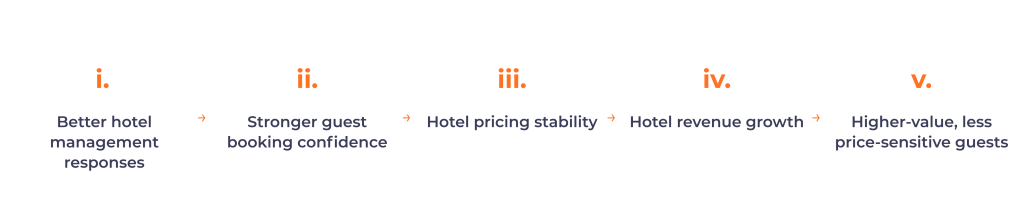
Better hotel management responses lead to stronger guest booking confidence. Stronger hotel guest confidence supports hotel pricing stability. Hotel pricing stability supports hotel revenue growth. And a growing online hotel reputation attracts higher-value hotel guests who are inherently less price-sensitive — creating a self-reinforcing revenue cycle that benefits every metric your hotel revenue team manages.
Hotel management responses to online reviews frequently serve as the first impression of the hospitality and service culture guests can expect when staying at your property. That first impression shapes whether future travelers view your hotel as professionally managed, trustworthy, and worth your current average daily rate — before they ever evaluate a hotel room photo or review an amenity list.
Build Your Strategy
Build a Hotel Reputation Management Strategy That Protects Your ADR
If your hotel’s goal is simply to respond to online reviews, there are many approaches available. Hotel teams can assign hotel review management to front desk staff, hotel marketing departments, general managers, or third-party hotel review response vendors focused primarily on ticking the box. While those approaches may ensure hotel reviews receive replies, they rarely address the larger hotel revenue impact that strategic online reputation management creates — or the hotel guest experience improvements that make those management responses reflect operational reality.
The real hotel reputation management opportunity is not simply replying to guest feedback. It is ensuring every hotel management response actively supports how your property is positioned in the competitive market, and that the hotel guest experience driving those reviews is continuously improving through structured colleague training and engagement programs.
Hotel revenue leaders already understand that hotel ADR pressure rarely originates from a single guest complaint or operational issue. It develops from accumulated guest perception gaps that influence hotel booking conversion over time. Hotel review response management helps close those gaps by ensuring your hotel’s online reputation actively supports your broader hotel pricing strategy — rather than quietly working against it.
If your hotel frequently discounts room rates to remain competitive, struggles with inconsistent hotel management responses across platforms, or lacks the internal operational bandwidth to manage hotel reviews effectively, there are significant opportunities to strengthen hotel guest confidence before booking decisions happen.
A more thoughtful, structured hotel reputation management strategy can help your property improve public guest trust, strengthen hotel booking confidence, reduce unnecessary hotel pricing discounts, support long-term average daily rate stability, and create stronger hotel brand perception — across every online platform where your future hotel guests are making booking and pricing decisions right now.
At The Reputation Lab, we work alongside hotel leadership teams to build that reputation management consistency — from the hotel guest interactions that shape online reviews to the hotel management responses that shape future traveler perception.
FAQ
Frequently Asked Questions About Hotel Review Responses and ADR
How do hotel review responses directly influence hotel average daily rate?
When travelers encounter consistent, thoughtful hotel management responses across review platforms, hotel booking confidence increases and hotel price sensitivity decreases. Research from Cornell University School of Hotel Administration found that a 1-point improvement in hotel review scores can allow properties to increase average daily rate by up to 11.2% while maintaining hotel occupancy levels. Hotel review responses are one of the primary online reputation management mechanisms through which that hotel review score improvement is built and sustained over time.
Why do unresolved hotel reviews create hotel pricing pressure?
Unanswered hotel reviews leave travelers to draw their own conclusions about hotel service quality and operational consistency. That uncertainty pushes hotel guests toward competing properties or back to OTA platforms where they continue comparing hotel alternatives — increasing hotel commission costs and creating downward pressure on achievable average daily rate. The hotel revenue problem compounds when multiple unanswered hotel reviews create a visible pattern of management disengagement across online review platforms.
Does hotel review response quality matter as much as hotel response rate?
Both hotel review response rate and response quality significantly influence hotel ADR performance, but response quality has a greater influence on hotel guest pricing confidence. A generic or defensively worded hotel management response can be more damaging to hotel reputation than no response at all. Thoughtful, specific hotel management responses that demonstrate genuine accountability reinforce perceived hotel value more effectively than response volume alone — and that perceived hotel value is what directly supports premium hotel ADR performance.
Which hotel segments benefit most from structured hotel review response management?
All hotel market segments benefit from consistent online reputation management, but the hotel ADR impact is most significant for luxury hotel properties, destination resorts, convention hotels, and group-focused properties where higher hotel booking values attract greater traveler scrutiny. Meeting planners, corporate hotel travel managers, and international hotel travelers place particular weight on hotel management engagement patterns when evaluating and selecting hotel properties.
What is the difference between hotel review response management and full hotel reputation management?
Hotel review response management covers the reactive online reputation management layer — daily hotel review monitoring and brand-aligned hotel management responses across major review platforms. Full hotel reputation management adds the proactive layer: hotel guest engagement training that improves the guest interactions driving hotel reviews, weekly hotel strategy calls with property leadership, hotel reputation trend analysis, and competitive set benchmarking. The proactive hotel reputation management layer is what drives sustainable improvement in hotel review volume, hotel review score performance, and ultimately hotel ADR confidence over time.
What is the revenue impact of improving hotel review response engagement?
Consider the number of travelers who read your hotel’s reviews each month across Tripadvisor, Google, Booking.com, and Expedia. For many hotel properties, that combined audience reaches 10,000 or more monthly readers — travelers actively researching your property before making a booking decision.
Now consider what a modest improvement in booking conversion means at that scale.
A 0.5% lift in conversion among those readers — driven by stronger hotel management responses that reduce booking hesitation and build guest confidence — translates to 50 additional reservations per month. Multiply those reservations by your average length of stay. Multiply that by your average daily rate.
For a hotel averaging a 2-night stay at $200 ADR, that is $20,000 in additional monthly revenue from a half-percent conversion improvement. For higher-rated properties or longer average stays, the number compounds significantly.
The question is not whether hotel review response management influences booking conversion. The question is how many reservations your current hotel management responses are leaving on the table each month — and what a structured, consistent hotel review response strategy could recover.
How does The Reputation Lab approach hotel review responses differently than other hotel reputation management vendors?
Most hotel review response vendors focus on response volume and turnaround speed. The Reputation Lab focuses on hotel revenue outcomes. Every hotel management response is crafted with future travelers’ hotel booking and pricing decisions in mind — reducing guest hesitation, reinforcing hotel operational credibility, and building the consistent online public record that supports stronger hotel ADR performance over time. We also work directly inside hotel properties through our Guest Engagement Training program, improving the hotel guest interactions that shape online reviews before they are ever written — addressing both sides of the hotel online reputation management equation simultaneously.